Browse the festa calendar for the full listing with locations and details.
Malta and Gozo festa dates 2026
A festa's date is set by its patron saint, but the main celebrations always peak on the nearest weekend, especially the Saturday eve and the Sunday feast day. Below are the major feasts by month. This is a selection of the largest and best known; Malta has over 100 in total across both islands.
June
The season builds through June. Highlights include St Philip in Żebbuġ (Malta) and the Sacred Heart in Fontana, Gozo in mid-June, Our Lady of the Lily in Mqabba, St Catherine in Żejtun and St John the Baptist in Xewkija, Gozo (beside the vast Xewkija Rotunda) around 21 June, and the huge feast of St Peter and St Paul, known as l-Imnarja, on 29 June, celebrated in Nadur, Gozo and Mdina. Nadur is famous for some of the most powerful fireworks on the islands.
July
One of the busiest festa months. Victoria (Rabat) in Gozo celebrates St George on the third Sunday of July, one of the island's grandest feasts centred on St George's Basilica. Għarb, Sannat (St Margaret, around 26 July) and many Malta villages hold their feasts through the month. Warm evenings and near-nightly fireworks somewhere on the islands.
August: the peak of the season
August is when the festa season reaches its climax, above all on 15 August, the feast of Santa Marija (the Assumption). It is a national public holiday celebrated simultaneously in seven localities: Mosta, Mqabba, Qrendi, Gudja, Attard, Għaxaq and Victoria in Gozo. No other date sees this many villages hold their main feast at once. The eve, 14 August, is the most intense fireworks night of the entire year, with Mqabba's famous displays drawing crowds from across the island. Qala in Gozo celebrates St Joseph on the first Sunday of August.
September
The season winds down but is not over. Victory Day on 8 September (Il-Vitorja, also the feast of the Nativity of Our Lady, the Bambina) is celebrated in Naxxar, Senglea, Xagħra in Gozo and Mellieħa, and is a national holiday marking the lifting of the sieges of 1565 and 1943. Early September still brings genuine festa atmosphere and fireworks.
October
The final feasts of the year, including Our Lady of the Rosary celebrations in several villages, close the season in early October before the islands turn toward autumn.
For exact dates, weekends and locations of every 2026 feast including the smaller village celebrations, the GoGather festa calendar carries the full list.
What a festa actually is
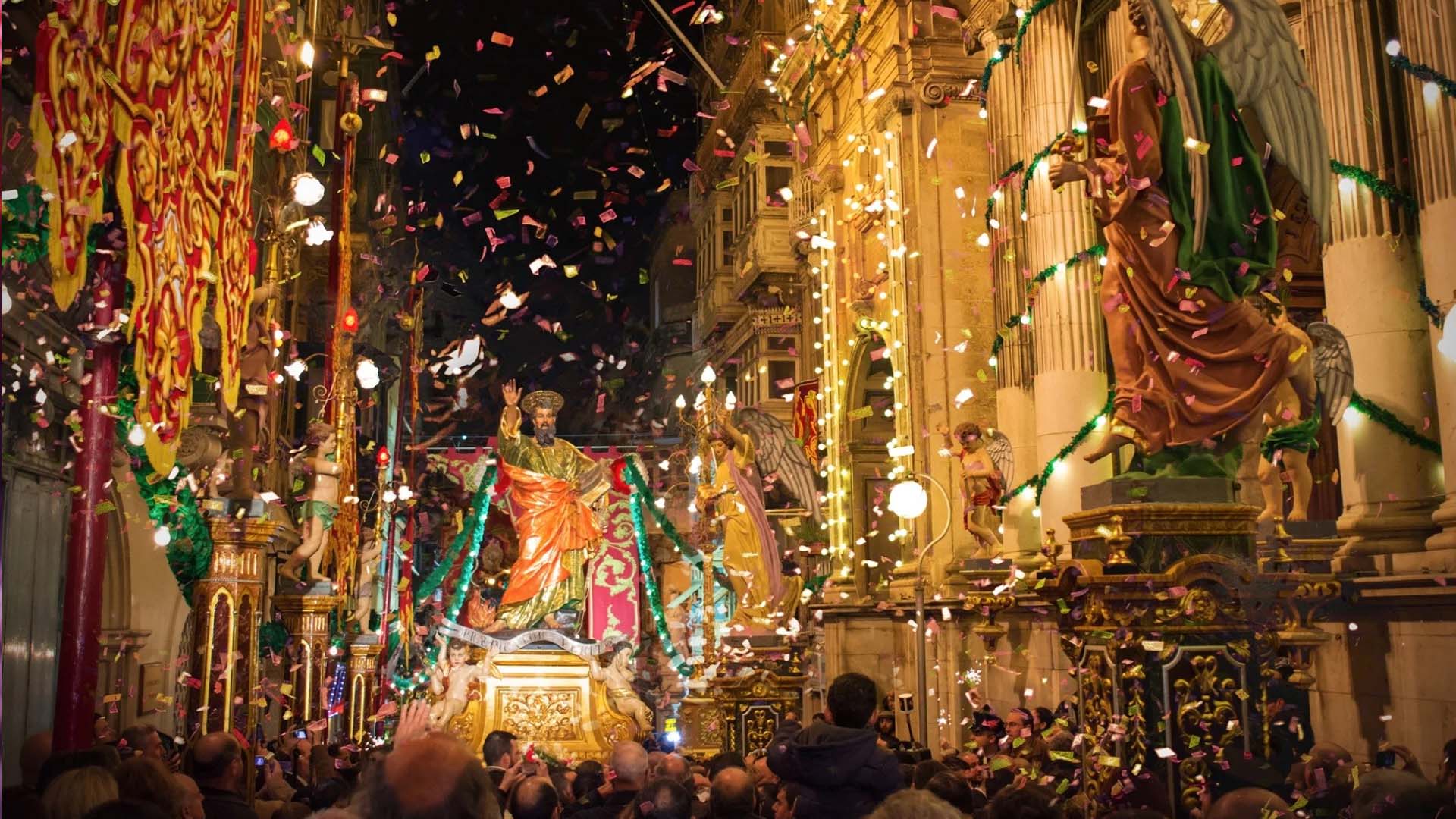
A festa is a multi-day celebration honouring a parish's patron saint, run entirely by volunteers from the village band clubs (każini) and fireworks societies. Expect brass band marches, the parish church illuminated and elaborately decorated, statues of the saint carried through the streets, food stalls, and fireworks displays that rival professional shows anywhere in Europe.
The emotional peak comes on the feast day, usually the Sunday, when the patron saint's statue is carried through the village on the shoulders of volunteers. For the community this is the most important weekend of the year, and the friendly rivalry between neighbouring villages, and between band clubs within the same village, is a huge part of what makes it so alive.
The fireworks villages
Maltese fireworks are a craft, handmade in village factories and set off by volunteer pyrotechnicians who compete fiercely for the best display. Mqabba is widely considered Malta's fireworks capital, and the eve of Santa Marija on 14 August is the most intense pyrotechnic night of the year. In Gozo, Nadur (29 June) and Victoria are known for the most ambitious fireworks programmes. Lija in Malta, celebrating the Transfiguration in early August, is famous for its fireworks competition between rival factions.
If fireworks are your main interest, the Malta International Fireworks Festival each spring is a more formal showcase of the same craft over the Grand Harbour, a good introduction before the raw village version.
How to experience a festa like a local
Go by bus, not by car. Roads around the village close early and parking near the centre is a genuine headache; the bus drops you close and removes the problem.
Time your arrival for the fireworks. Aim to be in the village at least 90 minutes before the main display, because the streets around the church square fill fast. The eve of the feast, the Saturday, is usually the biggest fireworks night, often bigger than the feast day itself.
Bring cash. Everything is free to enjoy, but you will want cash for the food stalls, the nougat (qubbajt) and imqaret (date pastries), and the band club bars, which are the social heart of the village and where you get the best and cheapest drink.
Watch the procession. The statue leaves the church in the late afternoon or early evening on the feast day. This is the most emotionally powerful moment of the whole festa. Dress respectfully if entering the church: shoulders and knees covered.
Expect noise. Petards, the ground-level fireworks, are set off throughout the week, often early in the morning. If you are staying near a festa village, pack earplugs.
When is the best time to see a festa?
If you can visit in August, do. The season peaks around Santa Marija on 15 August, when seven villages celebrate at once and the fireworks are at their most spectacular. June and July are also excellent, with feasts almost every weekend. Even into September, Victory Day on 8 September brings genuine festa atmosphere. Whenever you visit between June and early October, you are very likely to catch one.
Planning your visit
The GoGather festa calendar lists upcoming village feasts with dates and locations, and the community events calendar covers the wider programme of local celebrations. Because festas cluster on summer weekends and the biggest ones tighten accommodation across the islands, it is worth checking dates before you lock in where to stay.
For more of the local, traditional side of Malta, our local's guide to Valletta and our guide to Malta's food festivals and markets both point toward the most authentic experiences on the islands.